
Your software holds the same information three times, and never the same version.
The site, the back office, the till and the CRM do not talk to each other. Somebody re-keys. The figures diverge. We build the links that are missing — monitored, logged, and able to recover after a failure.
- From
- 2 900TND
- or
- 2 400€ excl. VAT
- First feed in
- 4weeks
- Quote within
- 24hours
The symptom is double entry. The cause is elsewhere.
Orders from the site get re-keyed into the back office. The stock shown online is not the stock in the warehouse. Sales works from a customer file that finance does not recognise. Everyone is right inside their own tool, and nobody has the same figure in the meeting.
Double entry is only the visible part. The real cost is elsewhere: nobody knows which version is authoritative any more, and decisions get made on figures people doubt.
So a good integration is not plugging everything into everything. It is deciding, for each piece of information, which system owns it — and making the information flow out from there, in one direction.
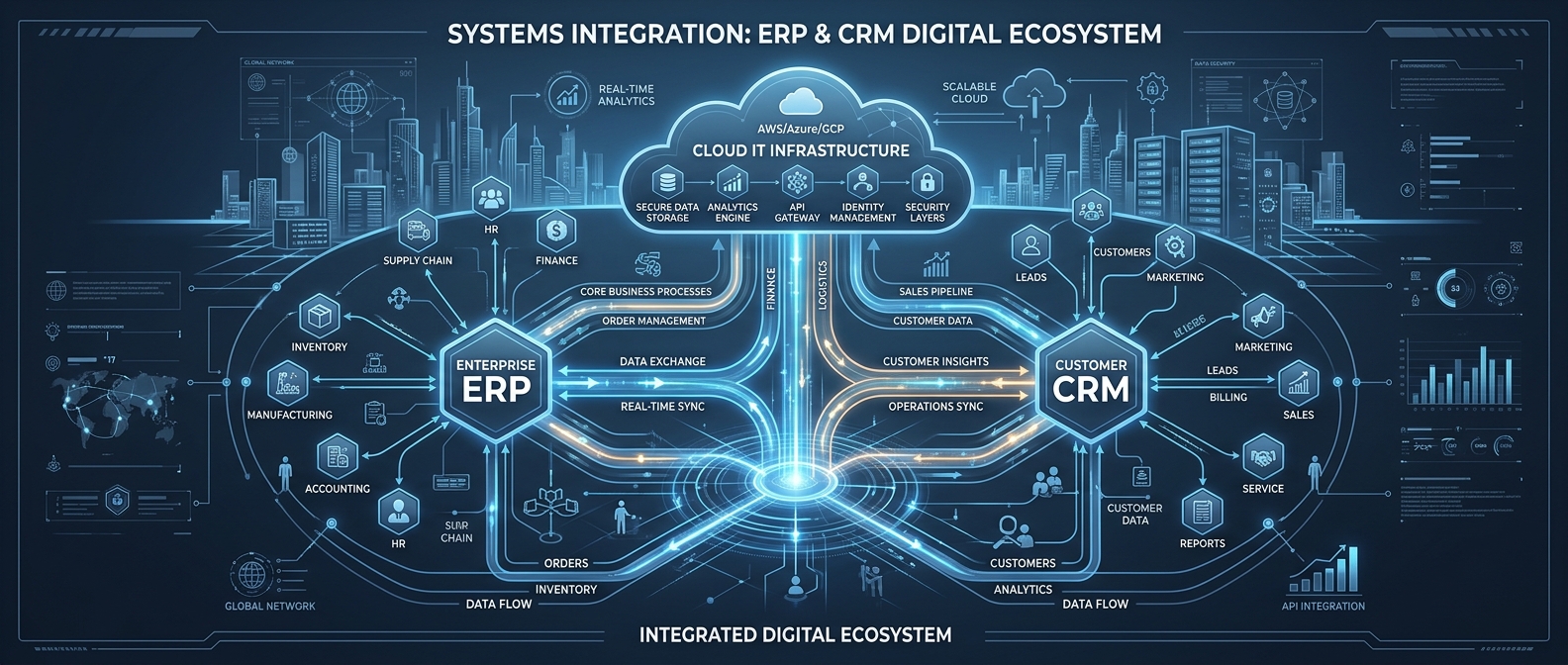
One owner per piece of data, and a feed that knows how to fail.
The first piece of work is a table, not code: which information lives where, who has the right to change it, and in which direction it travels. Stock belongs to the back office, the customer to the CRM, the order to the site. That table fits on one page and it avoids three quarters of the problems.
Then come the feeds. A serious feed is not a connection that works on acceptance day: it is a mechanism that knows what to do when it fails. The server on the other side does not answer, a record is rejected, a duplicate appears. Without retries or alerts, the information disappears silently — and you find out three weeks later, during a stocktake.
So we deliver every feed with a readable log, automatic retries, a named alert on repeated failure, and a queue that holds whatever did not get through.
The most requested links.
| Link | What travels | Direction |
|---|---|---|
| Store to back office | Orders, customers, payments | One way |
| Back office to store | Stock, prices, product records | One way |
| Site to CRM | Forms, quote requests, source of the contact | One way |
| Till and store | Unified stock between the point of sale and the web | Two ways |
| Accounting | Journal entries, invoices, settlements | One way |
| Shipping | Notes, labels, tracking numbers | Two ways |
One feed in service, and the means to watch it.
The entry figure covers one feed between two systems, in one direction, with its full monitoring.
Included in the price
- A map: which data lives where, and who changes it
- Field mapping table, approved by you
- The feed built and connected to both systems
- Automatic retries and a queue on failure
- Named alert if a failure repeats
- Readable log, without going through us
- Existing history migrated
- Acceptance on real data, alongside the current process
- Operating documentation
Billed separately, and quoted up front
- Third-party vendor licences and modules
- Development inside your ERP
- Bulk migration or cleanup of inconsistent data
- Changing ERP or CRM
- Training your teams on their own tools
- Hosting the third-party systems
Per feed, because that is what can be measured.
- Tunisia, one feed
- from2 900TND
- France, Europe, international
- from2 400€ excl. VAT
This figure covers one feed between two systems that both have a documented programmable interface. Two situations push it up, and we identify them before quoting: a closed system, with no interface, where everything has to go through exports; and inconsistent source data, which has to be cleaned before anything can be connected at all.
We always start with a single feed, the one that costs the most time. It serves as the proof and it makes the rest quotable on facts. Integration projects decided in advance across ten feeds are the ones that derail.
Four weeks, and nothing switches without a comparison period.
Mapping
An inventory of the systems, the data and their owners. Access to the interfaces on both sides, and a check on what they actually allow — that is often where the unpleasant surprises appear.
Days 1 to 6Field mapping
The table saying which field matches which, which values are accepted, what happens on a duplicate or an empty field. Approved by you before any development.
Days 7 to 11Build
The feed, its retries, its alerts and its log. Acceptance on real data, in a separate environment.
Days 12 to 22Parallel running and switch-over
The feed runs alongside the manual process for several days, and results are compared. The switch happens only once the differences are explained.
Days 23 to 28
What people ask before they sign.
What if our ERP has no programmable interface?
Common on older or very local software. We then go through file exchange — scheduled exports, dropped on a server, picked up automatically — or by reading the database directly where the vendor allows it. It is less elegant, slower, and we say so at scoping, with the extra cost.
Do we need to change ERP?
Almost never, and it is not what we sell. Changing ERP is a project of an entirely different order, with a risk of an entirely different order. Our job is to make what you have work. If your tool really is a dead end, we tell you — but that is rare and it has to be demonstrated.
Real time or in batches?
Depends on the use, and it is a genuine decision. An order has to come down in real time. Stock can be synchronised every fifteen minutes without anyone noticing. Real time costs more to build and to run: we keep it for what genuinely justifies it.
How do we know it is working?
You have an accessible log showing every exchange, its result and how long it took, plus a named alert on repeated failure. You do not have to ask us whether the feed is running: you can see it. It is the first thing we put in place, before the feed itself.
Do you work with Business Central, Odoo, Sage?
Yes, and with less common systems too, including local ERPs in Tunisia. We have delivered integrations on Microsoft environments and on open-source stacks alike. What matters is not the brand but what its interface actually allows — and that is the first thing we go and check.
Two ways to start.
You know what you want
Describe what you need in a few lines. You get a priced quote, with the scope and the dates.
Request a quote Answer within 24 business hoursYou would rather talk it through
Message us on WhatsApp or call. Fifteen minutes are usually enough to know whether your need fits the package — and we will tell you plainly either way.
Message us on WhatsApp TN +216 58 044 066 · FR +33 7 69 78 69 98